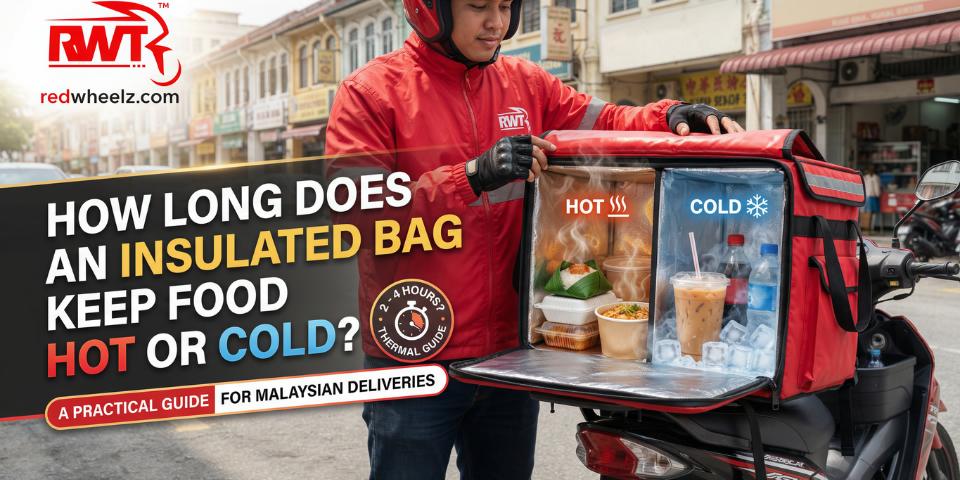
How long does an insulated bag keep food cold or hot: There is no single number. A good thermal delivery bag is designed to protect food through a normal delivery window, while a cooler box with ice packs can hold cold for hours. Real hold time depends on insulation quality, how full the bag is, whether you pre-chill or pre-heat it, how many ice packs you use, how often it is opened and the outside temperature. The only way to know for your own bag is to test it with a probe thermometer.
Ask three delivery businesses how long does an insulated bag keep food cold or hot and you will get three answers. That is because hold time is not a fixed specification. It changes with the bag, the food and the weather, and Malaysia’s heat makes the difference bigger. Here is how to work out a realistic number for your operation.
What decides how long does an insulated bag keep food cold or hot?
- Insulation thickness and material: thicker foam and a reflective lining slow heat transfer.
- Seal quality: zips, flaps and Velcro closures that leave gaps let heat in or out.
- Starting temperature: food packed hot (or properly chilled) lasts longer than lukewarm food.
- Fill level: a bag packed snugly holds temperature better than one with a lot of empty air space.
- Ice or heat packs: the number, size and how frozen they are matters for cold loads.
- Opening frequency and ambient heat: every opening lets conditions in, and a bag on a sun-baked motorcycle box works harder.
What temperatures should delivered food stay within?
Commonly cited food safety guidance treats roughly 5°C to 60°C as the danger zone, where bacteria multiply fastest. Hot food should stay above that range and cold food below it. Many food safety agencies also advise that perishable food should not sit in the danger zone for more than two hours, or just one hour when the air temperature is above about 32°C, a level Malaysian afternoons often reach. Check the current guidance from the Ministry of Health for your food category.
What hold time should you expect for each use case?
| Use case | Typical setup | What to plan for |
|---|---|---|
| Hot meals, short rider trips | Standard thermal delivery bag, pre-heated for a few minutes | Designed for normal delivery windows; test with your longest route |
| Cold desserts, salads, drinks | Insulated bag plus frozen gel packs | Keep trips short and keep the bag closed |
| Catering or grocery runs lasting hours | Cooler box with enough ice packs | Hold time stretches, but minimise openings |
| Vaccines and medicines | Validated vaccine carrier with monitoring | Do not use a general food bag |
Not sure whether you need a bag or a box? Read insulated bag vs cooler box.
How many ice packs do you need?
For coolers, a common rule of thumb is to use between one and two times as much ice by volume as food on long or hot trips, and less on short ones. Treat that as a starting point, not a guarantee. Freeze packs solid, place them above and around the food (cold air sinks), and fill gaps so air cannot circulate.
How to test your insulated bag in 5 steps
- Pre-chill or pre-heat the bag as you normally would.
- Load it with the same food, containers and ice packs you use in real deliveries.
- Put a probe thermometer in the thickest or warmest item and close the bag.
- Record the temperature every 15 minutes, and leave the bag where it would sit during a delivery, such as in the sun or on a bike.
- Note when the food crosses the safe range. That time, minus a safety margin, is your real hold time.
Repeat the test on a hot afternoon. If the result is too short, upgrade the bag, add packs or shorten your routes.
What mistakes shorten hold time?
- Opening the bag repeatedly to check the order.
- Mixing hot and cold items in one compartment.
- Using a bag that is too large for the load. See the food delivery bag size guide.
- Dirty, damp or worn liners and torn seams. Follow our guide to cleaning a thermal delivery bag.
- Leaving the bag in direct sun between jobs.
When is it time to upgrade?
If testing shows food leaving the safe range before your longest delivery ends, if liners peel, or if seams leak, replace the bag. Confirm that materials are food-grade (see food-grade materials) and consider custom branded bags when you order for a fleet.
Frequently Asked Questions
Do insulated bags keep food hot?
Yes, they slow heat loss, but they do not generate heat. Pre-heating the bag and packing hot food promptly gives the best result.
Can I put hot and cold food in the same insulated bag?
It is better not to. Each item then works against the other. Use separate bags or compartments.
How can I keep food hot for longer during delivery?
Pre-heat the bag, pack food hot, keep air space low, avoid opening the bag, and use a bag with thicker insulation and a tight seal.
Need bags that fit your menu and routes?
Red Wheels Trading supplies thermal delivery bags, insulated bags and cooler boxes in Malaysia, with OEM and custom-branding options. Send us your food type, delivery times and fleet size for a recommendation.