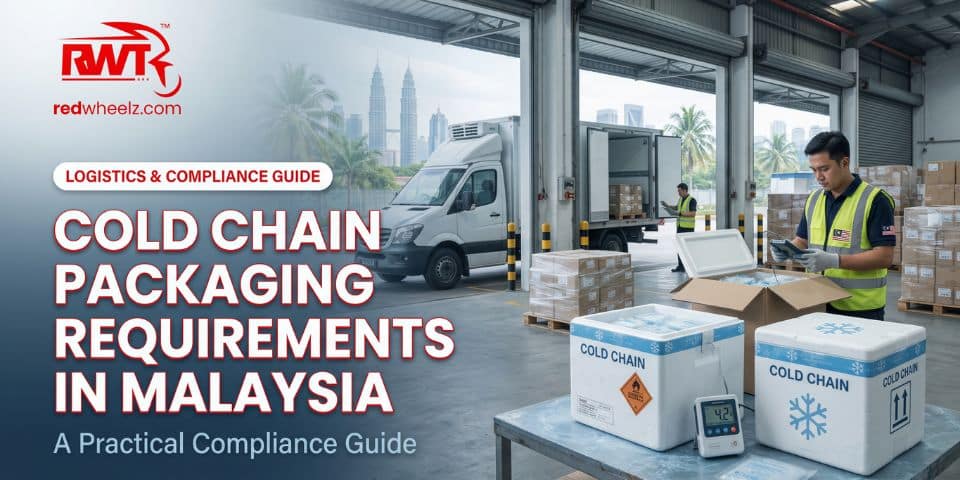
If you ship chilled food, frozen goods or medicines in Malaysia, the packaging is part of the regulated product. Cold chain packaging requirements in Malaysia depend on what you move, and the rules sit in several different documents. The last mile is where most cold chains break, so this guide pulls the rules together and shows where packaging decisions matter most.
What are the cold chain packaging requirements in Malaysia?
Malaysia has no single standalone cold chain packaging law. Requirements come from the sector: the Food Act 1983 with its Food Regulations 1985 and Food Hygiene Regulations 2009 for food, the NPRA Good Distribution Practice (GDP) guideline for medicines, and MS 2400 for halal integrity. The common thread is validated packaging, continuous temperature monitoring, clear labelling and records.
Which rules apply to your product?
| Product | Main source | What it means for packaging |
|---|---|---|
| Food and beverages | Food Act 1983, Food Regulations 1985, Food Hygiene Regulations 2009 (Ministry of Health) | Hygienic packing, storage and carriage; registered food premises |
| Medicines, vaccines, biologics | NPRA Guideline on Good Distribution Practice (3rd ed., 2018) and its Annex 1 on time and temperature sensitive products | Qualified containers, monitored packs, documented procedures |
| Halal-certified goods | MS 2400 (transport, warehousing, retail) | Halal integrity maintained through the whole chain |
| Fresh, chilled and frozen poultry | MS 361 (a revision was out for public comment in 2025) | Product temperature limits during handling |
The Ministry of Health’s Food Safety and Quality Programme explains that the Food Hygiene Regulations 2009 set controls for food premises, owners and food handlers covering preparation, handling, storage and packaging. The regulations also include requirements for registering food premises and for handling, packing and carriage of food.
Pharmaceutical and healthcare cold chain packaging (NPRA)
This is where Malaysia is most specific. NPRA’s Guideline on Good Distribution Practice and its Annex 1 notes read like a packaging audit checklist. Here is what they ask for:
- Qualified shippers. Containers used to deliver temperature-sensitive products must be fully qualified as fit for purpose and able to hold each product’s temperature profile in transit, with documented evidence available on request.
- Verified packing. Packing operations follow written procedures and are checked by a second person, and the packaging is mapped and continuously monitored.
- Controlled coolant reuse. You need a system to stop incompletely cooled or expired gel packs being reused, with frozen and cool packs kept physically separate.
- Dry ice precautions. Dry ice must not touch the product directly.
- Clear labelling. Temperature-sensitive consignments must be identifiable from other products in the same delivery, and air freight packages follow IATA labelling rules.
- Receiving checks. On arrival, staff verify there are no signs of tampering, package damage or a deviation from the temperature profile.
- Monitored vehicles. Refrigerated vehicles and containers are mapped and continuously monitored with calibrated devices.
Excursions are handled with evidence rather than guesswork. A short excursion outside labelled conditions can be acceptable only if stability data and scientific justification show product quality isn’t affected. The notes also expect training for everyone who touches the product, including drivers.
NPRA also inspects facilities. Its GDP inspectors carry out cold chain facility inspections on importers and wholesalers handling time and temperature sensitive products, on request and routinely. If you’re choosing carriers for clinic or home deliveries, see our guide to vaccine carriers and pharma cold chain bags in Malaysia.
Food cold chain packaging
Food rules are less prescriptive about the shipper itself. They focus on hygiene, registered premises and product-specific temperatures. The Food Hygiene Regulations 2009 have dedicated chapters for fish (including carriage), milk temperature requirements and ice cream. Check the chapter for your product rather than assuming one rule fits all.
For poultry, the draft MS 361 describes frozen product as carcass and parts held at an internal temperature of -18 °C or below. Because it’s a draft, confirm the final published text before building specifications around it.
Beyond the law, here is what good food packaging looks like in practice (best practice, not a quoted legal requirement):
- Use food-grade, leak-proof inner packaging so meat juices never reach other cartons.
- Separate raw from ready-to-eat items, even inside the same insulated shipper.
- Size coolant to the longest realistic transit time, not the average one.
- Put a data logger in at least one carton per shipment.
Hold time is the number everyone asks for, and there isn’t a universal one. Our breakdown of how long an insulated bag keeps food cold or hot explains why it varies with insulation, load and door-opening.
Halal cold chain packaging (MS 2400)
If your goods carry halal certification, the packaging and handling must not compromise that status. MS 2400-2:2019 sets management system requirements for assuring halal integrity of products at the warehouse. Transport and retail are covered by Parts 1 and 3. Malaysia is a major halal hub, and temperature-controlled storage is a recognised value-added service in halal logistics.
In practice, that means keeping halal and non-halal products separated at every handover, including inside shared reefers and cold rooms. MS standards are voluntary unless a regulator or customer makes them mandatory.
Passive vs active cooling: choosing your packaging system
NPRA draws a clear line between the two:
| Passive | Active | |
|---|---|---|
| How it works | Insulated enclosure with a finite amount of pre-conditioned coolant such as gel packs, phase change materials or dry ice | Powered systems under thermostat control, such as cold rooms, refrigerated trucks and reefer containers |
| Best for | Parcels, last-mile, small pharma shipments | Pallets, bulk food, long-haul |
| Main risk | Coolant runs out before delivery | Power or equipment failure |
Within passive systems, the next choice is soft or rigid. We compare them in insulated bag vs cooler box: soft bags suit light, foldable last-mile work, while rigid boxes suit longer holds.
Malaysia is hot and humid year-round, so qualify passive shippers against worst-case conditions. NPRA’s notes say simulation studies can be used to validate delivery conditions, taking the worst situation into account. A shipper that passes on a cool morning and fails in a parked van at 35 °C hasn’t passed.
Common packaging mistakes
- Treating the shipper as validated because the supplier says so. You need your own evidence for your product and route.
- Reusing gel packs that aren’t fully conditioned. NPRA calls this out for a reason.
- No temperature record. Without a logger, you can’t prove an excursion didn’t happen.
- Household fridges for pharma storage. They’re acceptable only if independently tested against a recognised pharmaceutical refrigerator standard.
- Labels that don’t tell the driver what to do. “Keep frozen” or “Do not stack” needs to be visible on every carton.
Cold chain packaging compliance checklist
- Identify your product category and the authority that governs it.
- Write down the labelled storage range (the product’s stability data sets it).
- Choose passive or active cooling based on transit time and volume.
- Qualify the packaging against worst-case local conditions and keep the report.
- Write packing SOPs, with a second-person check for pharma.
- Add calibrated data loggers and define what happens on an excursion.
- Label clearly, including IATA marks for air freight.
- Train packers and drivers, and keep the training records.
- Check halal segregation if you hold certification.
- Review the rules yearly, because guidelines are revised.
Frequently asked questions
Is there one law for cold chain packaging in Malaysia?
No. Food falls under the Food Act 1983 and its regulations, medicines under NPRA’s GDP guideline, and halal integrity under MS 2400.
What temperature range do medicines need in transit?
It’s set by the product’s approved label and stability data, not by a fixed national number. NPRA expects transport under validated conditions that keep the labelled range.
Do I need data loggers?
For medicines, NPRA expects continuous monitoring of temperature-sensitive transport and monitored packaging. For food, a logger is strongly advisable as proof of control.
Are gel packs and dry ice allowed?
Yes. NPRA’s notes cover both, with rules on reuse, segregation and keeping dry ice away from direct product contact.
Where do I confirm the current version of a regulation?
Check the Ministry of Health’s Food Safety and Quality Programme for food and the NPRA website for medicines. This article is general guidance, not legal advice.
Need cold chain delivery equipment?
Red Wheels Trading is a Malaysian manufacturer of thermal bags and cold chain delivery equipment, including insulated trolley racks, trolley bags and insulated boxes. Browse our cold chain solutions or call our hotline on +60 12-281 7266. Whichever shipper you choose, qualify it against your own product and route.