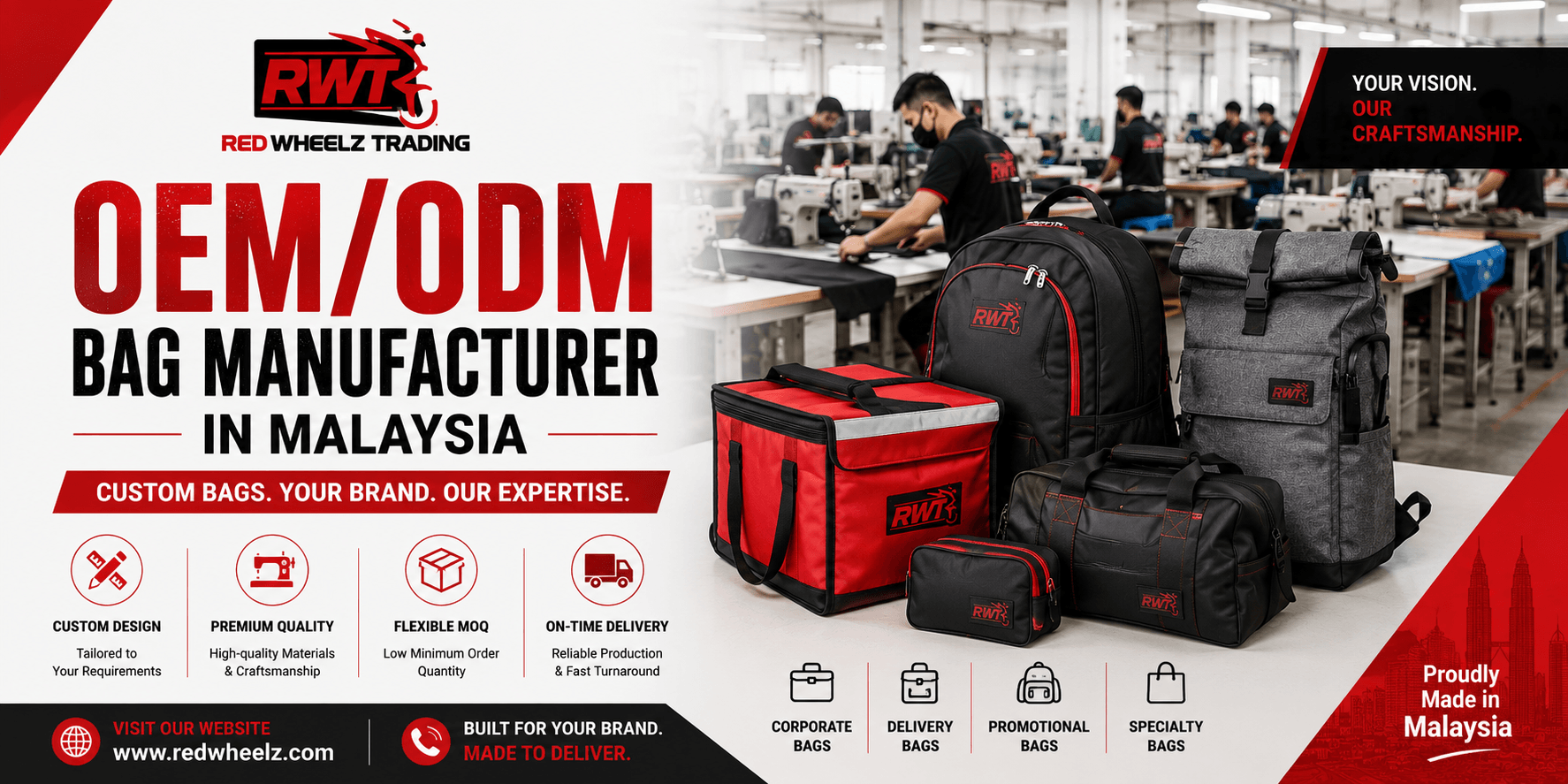
If you’re a food delivery platform, e-commerce brand, retailer, or logistics company looking to put your own branding on delivery bags, backpacks, or thermal packaging, you have two paths: buy generic stock bags and slap a sticker on them, or work with a proper OEM and ODM bag manufacturer (Original Equipment Manufacturer / Original Design Manufacturer) partner who builds the product around your specification from the ground up. The second option costs more upfront planning but produces a far better result and choosing the wrong manufacturer can mean failed quality checks, blown deadlines, or products that don’t survive real-world delivery conditions.
Here’s what to actually look for when evaluating a custom OEM and ODM bag manufacturer in Malaysia.
OEM and ODM Bag Manufacturer: What’s the Difference?
OEM (Original Equipment Manufacturer) means the factory builds a product to your exact specifications and design. ODM (Original Design Manufacturer) means the factory has existing product designs and templates that you can customize and brand as your own a faster, lower-cost route if you don’t need a fully bespoke design. A capable manufacturer should be able to support both models, depending on your budget, timeline, and how unique your product needs to be.

Certifications to Check Before You Commit
Certifications tell you whether a manufacturer’s quality claims are backed by independent verification, rather than just marketing copy. At minimum, look for:
- ISO 9001:2015: international quality management system certification
- SIRIM certification: Malaysian standards compliance
- Food-grade certification: essential if the bags will carry food or beverages, confirming materials are non-toxic, odorless, and safe for direct or indirect food contact
- Country-of-origin marks such as ‘Buatan Malaysia’ (Made in Malaysia), relevant if your brand or export market values local manufacturing provenance
Minimum Order Quantity (MOQ) and Flexibility
Many overseas factories require very high MOQs that don’t suit a growing Malaysian brand testing a new product line. A manufacturer offering low and small order quantities makes it realistic to trial a design, order a smaller first production run, and scale up once the product proves itself in the market rather than committing to a large volume before you know how it performs.
R&D Capability and Sample Testing
A manufacturer with genuine R&D capability can advise on material selection, insulation performance, stitching durability, and design feasibility, not just execute a drawing you hand them. Look for a defined process: product and market advice, sample production and testing, packaging design, regulatory registration where applicable, manufacturing, and quality control before delivery. Skipping the sample and testing stage is one of the most common reasons custom bag orders go wrong, problems that would have shown up in a sample surface instead in a full production run of thousands of units.
Export Experience and International Compliance
If you plan to sell or ship your branded bags beyond Malaysia, your manufacturer’s export track record matters. A factory with established duty-free export certifications to markets such as Australia, India, South Korea, Japan, Turkey, and New Zealand has already navigated the customs and compliance requirements for those destinations, which saves you from discovering export barriers after your product is already made.
Track Record and Proof of Scale
Ask how long the manufacturer has operated, who their existing clients are, and whether they have any independently verified achievements. Red Wheels Trading (M) Sdn Bhd, for example, has been manufacturing custom delivery bags, thermal bags, cooler bags, raincoats, backpacks, and travel luggage since 2013, and holds ISO 9001:2015 and SIRIM certification along with a Malaysia Book of Records achievement for its bag manufacturing. A manufacturer’s history of serving e-commerce and food delivery companies at scale is a reasonable proxy for whether they can reliably deliver your order too.
Frequently Asked Questions
What’s the difference between OEM and ODM bag manufacturing?
OEM means the factory builds a product to your exact custom specification. ODM means you customize and brand an existing design template. Most established manufacturers, including Red Wheels, offer both routes depending on your budget and timeline.
What certifications should a Malaysian bag manufacturer have?
At minimum, look for ISO 9001:2015 quality management certification and SIRIM compliance. If the bags will carry food, food-grade material certification is essential.
Can I order a small quantity for a first production run?
Yes, if you choose a manufacturer that offers low and small order quantities, this lets you test a design in market before committing to a large order.
Can a Malaysian OEM bag manufacturer handle export orders?
Manufacturers with existing duty-free export certifications to markets like Australia, India, South Korea, Japan, Turkey, and New Zealand have already handled the compliance side of exporting, which reduces risk for your international orders.
Conclusion
Choosing an OEM/ODM bag manufacturer is a decision that affects your product quality, your timeline, and if things go wrong your brand’s reputation with customers. Prioritise certifications, a genuine sample-and-testing process, MOQ flexibility, and a proven track record over the lowest quoted price alone. Red Wheels Trading has manufactured custom delivery bags, thermal packaging, and branded bag solutions for e-commerce and food delivery businesses across Malaysia and internationally since 2013, get in touch to discuss your specification and MOQ.